
Stock (Symbol) |
TJX (TJX) |
Stock Price |
$125 |
Sector |
| Retail & Travel |
Data is as of |
| September 15, 2026 |
Expected to Report |
| November 18 |
Company Description |
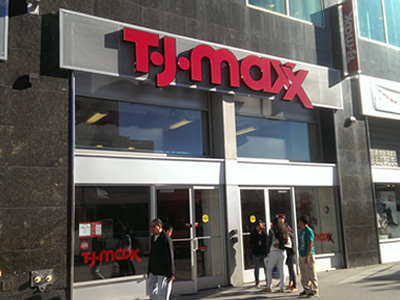 TJX Companies, Inc. (TJX) is an off-price apparel and home fashion retailer in the United States and across the world. TJX Companies, Inc. (TJX) is an off-price apparel and home fashion retailer in the United States and across the world.
The Company operates through four segments: Marmaxx, HomeGoods, TJX Canada, and TJX International. T.J. Maxx and Marshalls chains in the United States (Marmaxx) are collectively the off-price retailers in the United States with approximately 2,532 stores. The HomeGoods chain is an off-price retailer of home fashions in the United States with approximately 922 stores. The TJX Canada segment operates the Winners, HomeSense, and Marshalls chains in Canada. Winners is the off-price apparel and home fashion retailer in Canada. HomeSense offers home fashions off-price concepts in Canada. The TJX International segment operates the T.K. Maxx and HomeSense chains in Europe. Through its stores and its e-commerce site for the U.K., tkmaxx.com, T.K. Maxx offers a merchandise mix similar to T.J. Maxx. Source: Refinitiv |
Sharek’s Take |
 Last quarter, TJX maintained double-digit profit growth, with profit up 11% on a 5% increase in revenue as same store sales (SSS) increased 4%. But the stock went into a free-fall after earnings as Marmaxx (TJ MAxx, Marshalls, and Sierra) had SSS growth of a measly 1%. Marmaxx SSS growth was 9% just a quarter earlier, so this was a big slowdown. On the bright side, International operations and HomeGoods recorded 7% SSS growth last quarter. TJX stock went from $154 to $125 since our report last quarter, but the P/E has fallen from 29 to 24 as the stock’s gone from overvalued to undervalued in my opinion. Last quarter, TJX maintained double-digit profit growth, with profit up 11% on a 5% increase in revenue as same store sales (SSS) increased 4%. But the stock went into a free-fall after earnings as Marmaxx (TJ MAxx, Marshalls, and Sierra) had SSS growth of a measly 1%. Marmaxx SSS growth was 9% just a quarter earlier, so this was a big slowdown. On the bright side, International operations and HomeGoods recorded 7% SSS growth last quarter. TJX stock went from $154 to $125 since our report last quarter, but the P/E has fallen from 29 to 24 as the stock’s gone from overvalued to undervalued in my opinion.
TJX is the largest major international off-price retailer in the world, which operates in the U.S. since 1976, in Canada since 1990 (Winners), and in the U.K. and Ireland since 1994 (where its stores are named as T.K. Maxx). The company offers a rapidly changing assortment of quality brand names and designer merchandise that is 20% to 60% below full-price retailers. TJX is a powerhouse, with 1,400 buyers that source goods from 21,000 vendors in over 100 countries. The company traces its roots back to 1956 when the Zayre discount department store was founded. The company opened its first T.J. Maxx in 1976, and eventually sold the Zayre brand to Ames in 1988, then was renamed to TJX Companies and focused on T.J. Maxx. As of August 1, 2026, TJX had 5285 stores in operation. Management expects it can expand by over 1,700 stores worldwide in the coming years, aiming for a long-term total of 7,500 locations. TJX divisions include:
TJX has been an all-time stock market winner as it soared from $0.05 to $157 since 1980. It is currently around a 10% to 12% grower that also pays a 1% dividend yield. Store expansion of 5%, in addition to mid-single-digit same-store sales and a large stock buyback program, makes it possible for TJX to grow profits at a low double-digit rate (maybe 10% to 12% per year). Prior to 2020, TJX raised its dividend every year since 1996 at an average rate of more than 20%. Sadly, management stopped paying the dividend during the COVID-19 outbreak. It’s since been reinstated. The company buys back stock too. In 2025, management bought back $2.5 billion in stock and paid $1.8 billion in dividends. 2019 was TJX’s 24th consecutive year of same-store sales increases, but that streak ended in 2020. TJX is a core holding in the Conservative Growth Portfolio. |
One Year Chart |
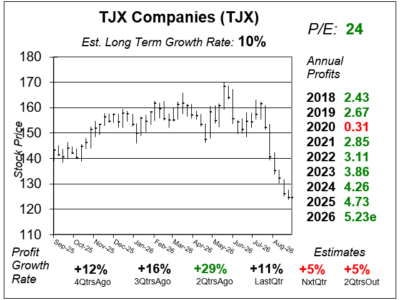 That was a nice base TJX was in, but the stock’s been overvalued the past nine quarters (according to our past research reports). So this decline was a nice washout. That was a nice base TJX was in, but the stock’s been overvalued the past nine quarters (according to our past research reports). So this decline was a nice washout.
With a P/E of 24, I think the stock is 13% undervalued. My Fair Value is a P/E of 27. The Estimated Long Term Growth is 10%, up from 9% last quarter. I have faith this company can grow profits 10% to 12% a year. Profit growth has been good over the past four quarters. Although growth is expected to simmer down, TJX has been beating analyst profit estimates. |
Earnings Table |
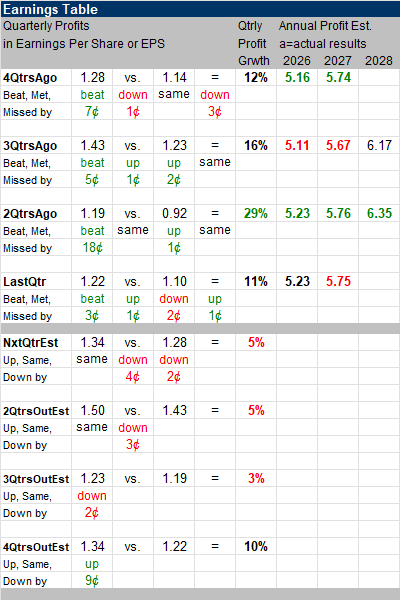 Last quarter, TJX delivered 11% profit growth and beat expectations of 8% growth. Revenue growth met estimates of 5%. SSS rose 4% driven by both higher average basket and increased customer transactions. Inventory grew 7% overall. Last quarter, TJX delivered 11% profit growth and beat expectations of 8% growth. Revenue growth met estimates of 5%. SSS rose 4% driven by both higher average basket and increased customer transactions. Inventory grew 7% overall.
Here are the divisional sales growth and SSS growth from last quarter:
Annual Profit Estimates are mixed this quarter. Management expects SSS to grow by 2–3% next quarter and 3–4% in 2026. Quarterly Profit Estimates for the next 4 quarters are 5%, 5%, 3%, and 10% growth. Looks like slower growth on the horizon unless TJX can beat the street. For the next quarter, analysts estimate revenue growth to be at 5%. |
Fair Value |
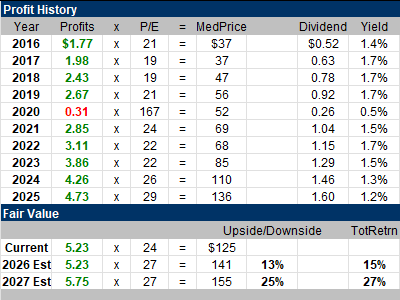 Note that during the past decade this stock often had median P/E between 19 and 22. Note that during the past decade this stock often had median P/E between 19 and 22.
This quarter, the stock is $125, giving it a P/E of 24. My Fair Value is a P/E of 27. So the shares are 13% undervalued in my opinion as I feel they are worth $141. TJX has a Fiscal year-end on January 31st. |
Bottom Line |
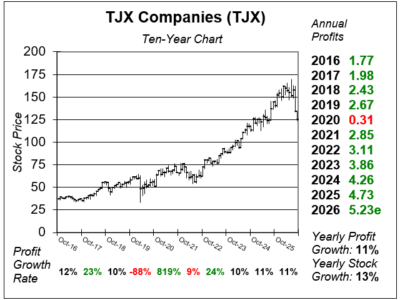 TJX (TJX) has been one of the stock market’s finest stocks the past 35 years. This is a well-oiled machine that is a juggernaut in the world of fashion. TJX (TJX) has been one of the stock market’s finest stocks the past 35 years. This is a well-oiled machine that is a juggernaut in the world of fashion.
TJX stock had a big flush after the stock had been in a long-term uptrend. I think the big reason for the decline was due to investors like me not wanting to overpay to buy the stock. TJX jumps into the top ten in the Conservative Portfolio Power Rankings. The stock moves up from 18th to 10th in the rankings. I’ll add to my position. |
Power Rankings |
Growth Stock Portfolio
N/AFocus List N/AConservative Stock Portfolio 10 of 19 |
