
Stock (Symbol) |
Sterling Infrastructure (STRL) |
Stock Price |
$470 |
Sector |
| Industrials & Energy |
Data is as of |
| August 31, 2026 |
Expected to Report |
| November 2 |
Company Description |
 Sterling Infrastructure, Inc. operates through a variety of subsidiaries, specializing in E-Infrastructure, Transportation and Building Solutions in the United States. Sterling Infrastructure, Inc. operates through a variety of subsidiaries, specializing in E-Infrastructure, Transportation and Building Solutions in the United States.
Its segments include E-Infrastructure Solutions, Transportation Solutions, and Building Solutions. The E-Infrastructure Solutions segment is a provider of large-scale specialty site infrastructure improvement contracting services in the Southeastern, Northeastern and Mid-Atlantic United States. It serves large, blue-chip end users in the e-commerce, data center, distribution center, warehousing, energy sectors and more. The Transportation Solutions segment is comprised of heavy highway, aviation, and rail, and relies heavily on federal and state infrastructure spending. The principal markets of this segment are Arizona, Colorado, Hawaii, Nevada, Texas, and Utah. The Building Solutions segment is comprised of its residential and commercial businesses. It focuses on concrete construction of multifamily foundations. Source: Refinitiv |
Sharek’s Take |
 Sterling Infrastructure (STRL) reported incredibly strong performance last quarter, as the construction company delivered 116% profit growth on a 90% increase in revenue. Why is STRL growing so fast? It builds Datacenters. Last qtr’s Growth was led by its E-Infrastructure Solutions segment, which had exceptional 192% revenue growth. This was supported by the continued strength in large mission-critical projects, including data center market, which also helped gross margin expansion. Sterling Infrastructure’s signed backlog also jumped 116% year-over-year, providing strong visibility into future revenue growth. But some of the backlog is due to acquisitions. Backlog increased 50% yoy excluding recent acquisitions COC and Stone Ridge. Sterling Infrastructure (STRL) reported incredibly strong performance last quarter, as the construction company delivered 116% profit growth on a 90% increase in revenue. Why is STRL growing so fast? It builds Datacenters. Last qtr’s Growth was led by its E-Infrastructure Solutions segment, which had exceptional 192% revenue growth. This was supported by the continued strength in large mission-critical projects, including data center market, which also helped gross margin expansion. Sterling Infrastructure’s signed backlog also jumped 116% year-over-year, providing strong visibility into future revenue growth. But some of the backlog is due to acquisitions. Backlog increased 50% yoy excluding recent acquisitions COC and Stone Ridge.
Sterling Infrastructure is a construction company that works with heavy machinery to tackle huge construction projects, like expanding highways and building water infrastructure. It is a heavy civil construction company founded in 1955 and based in Texas. The company’s building projects include roadways, airports, office and residential areas, highway rest stops, and schools. Although these projects are good for revenue, civil construction has low-profit margins. In 2016, management dedicated itself to growing high-margin projects and expanding into other markets. STRL has extended its services to building high-tech data centers, as well as e-commerce structures, including warehouses and distribution centers for clients such as Amazon, Facebook, Home Depot and FedEx. Today, Sterling Infrastructure has three business segments:
Sterling Infrastructure has an Estimated Long Term Growth Rate (Est. LTG) of just 11% but profits have been growing at a much faster rate. Profit growth has grown at triple-digit rates the past two quarters. STRL does not pay a dividend, but does buy back stock using an opportunistic approach. STRL is way off its highs and I will use the weakness to buy in for the Growth Portfolio at a good price. |
One Year Chart |
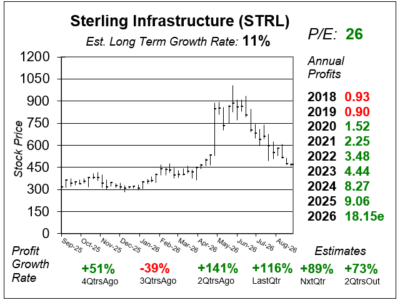 STRL stock has gone from around $300 to ~$1000 and back down to ~$500 this year. Shares jumped from $529 to $806 on May 5, the day after the company reported earnings 2QtrsAgo. The stock is down due to AI stocks taking a breather on news communities don’t want datacenters due to the electricity drain. STRL stock has gone from around $300 to ~$1000 and back down to ~$500 this year. Shares jumped from $529 to $806 on May 5, the day after the company reported earnings 2QtrsAgo. The stock is down due to AI stocks taking a breather on news communities don’t want datacenters due to the electricity drain.
This quarter’s P/E of 26, down from 30 last qtr. The Est. LTG is just 11%. I think that’s way too low. Quarterly profit growth has been strong the past two quarters, driven by higher profit margins. And Estimates for the next two quarters look great! |
Earnings Table |
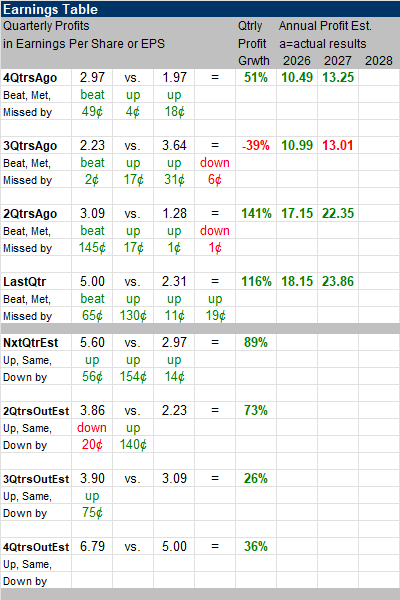 Last quarter, Sterling Infrastructure delivered profit growth of 116% and beat estimates of 88%. Revenue grew 90%. Gross margin increased to 24.8% from 23.3% a year ago as the company continued to shift its portfolio toward higher value, mission-critical projects. Operating margin was 18.8%, up from 17.0% a year ago. Last quarter, Sterling Infrastructure delivered profit growth of 116% and beat estimates of 88%. Revenue grew 90%. Gross margin increased to 24.8% from 23.3% a year ago as the company continued to shift its portfolio toward higher value, mission-critical projects. Operating margin was 18.8%, up from 17.0% a year ago.
Annual Profit Estimates are up this quarter. Considering Sterling Infrastructure’s strong performance to date, management raised its 2026 guidance to 64% revenue growth. Quarterly Profit Estimates are 89%, 73%, 26% and 36% profit growth in the next 4 quarters. Analysts think revenue will grow 71% next quarter. |
Fair Value |
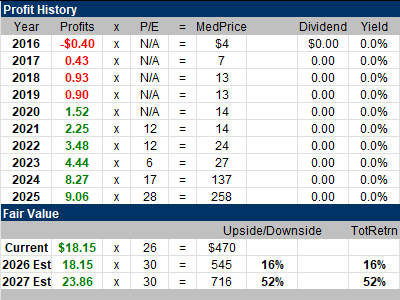 This company really pulled it together in 2020 as profits jumped 69% to record highs of $1.52 per share. STRL has been in a groove since. This company really pulled it together in 2020 as profits jumped 69% to record highs of $1.52 per share. STRL has been in a groove since.
With the stock at $470 this quarter, it has a P/E of 26. My Fair Value is a P/E of 30, which equates to $545 a share. This gives the stock an upside of 16%. Looking ahead to 2027, STRL has 52% upside in my opinion. |
Bottom Line |
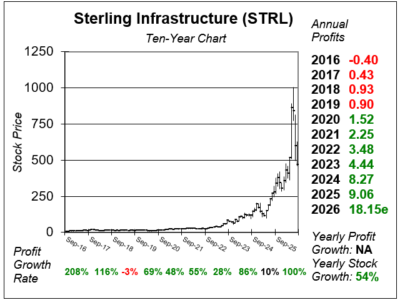 Sterling Infrastructure (STRL) has a pretty ten-year chart, but that hasn’t always been the case. What’s not shown here is between 2003 and 2005 the stock went from $2 to $25. That’s a big move in a short period of time. STRL set an all-time high of $33 in 2006, then trended lower until it sank to $2 in 2015. Management’s decision to evolve into other areas of construction turned the stock around. Sterling Infrastructure (STRL) has a pretty ten-year chart, but that hasn’t always been the case. What’s not shown here is between 2003 and 2005 the stock went from $2 to $25. That’s a big move in a short period of time. STRL set an all-time high of $33 in 2006, then trended lower until it sank to $2 in 2015. Management’s decision to evolve into other areas of construction turned the stock around.
I dropped the ball by not buying in when the stock went from $200 to $100 in early 2025, then again when STRL fell from $400 to $300 in late 2025. Now the stock is well off its highs once again. And I’m buying in. STRL will be purchased on Tuesday for the Growth Portfolio, and rank 26th in the Power Rankings. Monday is Labor Day, thus the stock market is closed. |
Power Rankings |
Growth Stock Portfolio
26 of 32Focus List N/AConservative Stock Portfolio N/A |
