
Stock (Symbol) |
SpaceX (SPCX) |
Stock Price |
$138 |
Sector |
| Industrials & Energy |
Data is as of |
| August 10, 2026 |
Expected to Report |
| N/A |
Company Description |
 Space Exploration Technologies Corp. designs, manufactures, launches, and operates products and services built on technologies, including rockets and spacecraft. The Company’s segments include Space, Connectivity, and artificial intelligence (AI). Its Space segment designs, manufactures, and launches reusable rockets to provide access to space. Its Connectivity segment operates broadband data and communications network powered by approximately 9,600 Starlink broadband and mobile satellites in Low-Earth orbit, delivering connectivity to consumer, enterprises, and government customers over 164 countries, territories, and other markets. In its AI segment, it operates a vertically integrated AI platform spanning its truth-seeking frontier model Grok, AI solutions for consumer and enterprise customers, X-its real-time information, entertainment, and free speech platform and AI computational infrastructure. Source: Refinitiv |
Sharek’s Take |
 SpaceX (SPCX) expanded beyond rockets and satellite internet as its Super Intelligence (SI) business rapidly expands to meet demand for AI compute. Last qtr, SpaceX’s SI business revenue jumped 830% year-over-year, driven by the activation of new cloud services agreements, the acquisition of Cursor, and increased Grok adoption across enterprise customers and consumers. Cursor is an AI-powered coding tool that helps developers write, edit, debug and understand code faster using artificial intelligence. SpaceX ended the quarter with 1.7 gigawatts of compute capacity and expects to reach 2.5 to 3 gigawatts by the end of October, while targeting around 13 gigawatts by the end of 2027. Meanwhile, Grok Bot — an AI agent that automates tasks and performs actions online — had already reached 800,000 paid weekly users, more than doubling over the previous month. Sales and profits estimates ramped up this quarter.
SpaceX (Space Exploration Technologies Corp.) is a space technology company by Elon Musk that designs, builds and launches rockets and spacecraft to carry satellites, cargo and astronauts into space. It develops reusable rockets that can return to Earth and fly again, helping reduce the cost of space travel. Its Starship program aims to transport people and cargo to the Moon and Mars, while its Starlink service uses a network of satellites to provide internet access around the world, including in remote areas. SpaceX also operates an artificial intelligence business that develops Grok, an AI assistant, and Cursor, a tool that helps people write computer code. It also operates X, the social media platform, and builds the computing infrastructure needed to develop and run its AI systems. Here are the three SpaceX operating segments, with last qtr’s revenue stats:
SPCX is an expensive stock with vast potential. The most impressive thing about SpaceX is the payback period on new capital deployments for compute is less than one year. That’s $1 going in and $1 in cash flow coming back within a year. The payback period for a business is often 5 to 10 years. That’s power plant level. And SpaceX will receive a very significant percent of NVIDIA’s GPUs next year. SPCX is part of the Growth Portfolio and Focus List. |
One Year Chart |
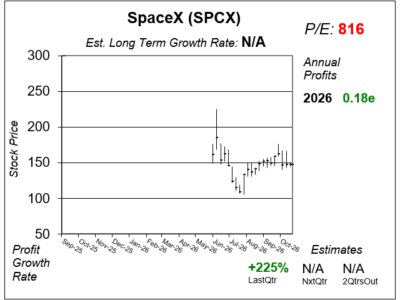 SPCX stock spiked after these earnings were announced, then immediately fell back. There is no Est. LTG. The P/E is high because the company just starting making a profit last quarter. |
Earnings Table |
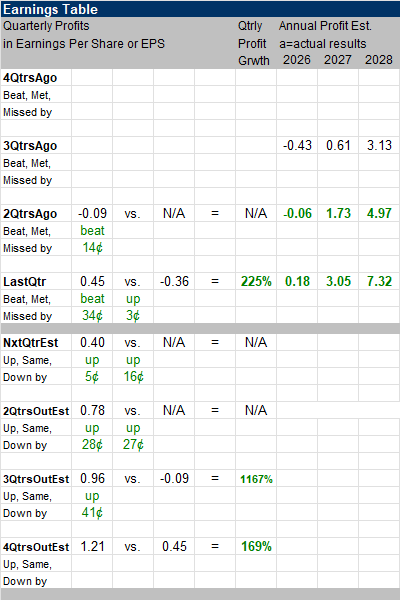 Last quarter, SpaceX reported $0.45 in profits, compared to analyst estimates of $0.11, up 225% year-over-year. Revenue grew 161% year-over-year.
Annual Profit Estimates increased this qtr. One big reason is growth in its Super Intelligence business, boosted by AI contracts and the Cursor acquisition. Qtrly Profit Estimates look good with estimates of $0.40 per share, $0.78 per share, $0.96 per share and $1.21 per share the next four quarters. There is no year-over-year revenue estimate for next qtr as the company wasn’t public a year ago. Analysts see revenue of $22.9 billion next qtr, up from $14.6 billion sequentially. Management guided total company revenues to be ~$35 billion 2QtrsOut. |
Fair Value |
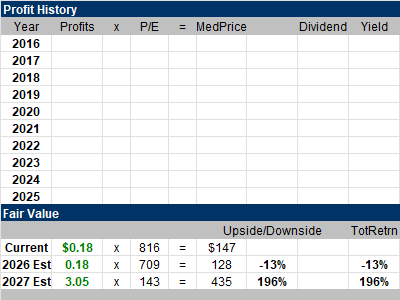 My SPCX Fair Value is 35x annual revenue. I think Palantir (PLTR) is worth 35x revenue too: Current: 2026 Fair Value: 2028 Fair Value: |
Bottom Line |
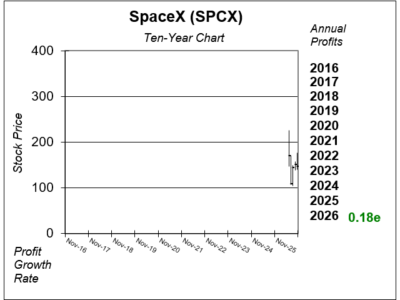 Space Exploration Technologies (SPCX) had a massive post-IPO run, reaching above $225 before falling sharply. The stock has since been under pressure, with the float more than doubling as locked-up shares entered the market. SpaceX’s momentum as a business is extraordinary. With revenue estimated to climb from $48 billion in 2026 to $164 billion in 2027, the potential for this stock is vast. Also, this is more a story on AI expansion (and being the most efficient at it) than a story about space. Risks include falling short of these lofty expectations and new shares of stock flooding the market. SPCX ranks 8th in the Growth Portfolio and Focus List Power Rankings. |
Power Rankings |
Growth Stock Portfolio
8 of 29Focus List 8 of 16Conservative Stock Portfolio N/A |
